I’d like you to please watch my brief video greeting before you read this article (below).
When people hear the word therapy, they often think of talking with a counselor in a quiet office. While talk therapy has helped countless individuals, newer approaches are showing that healing doesn’t always require long conversations. Two such methods—EMDR (Eye Movement Desensitization and Reprocessing) and Alpha-Theta Neurofeedback—may look very different on the surface. Still, both are effective for conditions like trauma, anxiety, and stress-related problems.
What is EMDR?
EMDR was developed in the late 1980s by Francine Shapiro, a psychologist. It is most often used for trauma and post-traumatic stress disorder (PTSD). During EMDR, a therapist asks you to bring up a troubling memory while guiding your eyes back and forth (or sometimes using sounds or taps on your hands).
The idea is that the rhythmic stimulation of the brain—paired with recalling the memory—helps the brain “digest” the experience in a way it couldn’t before. Many people describe feeling as though the memory becomes less “charged” or less painful, even though they still recall it.
In research, EMDR has consistently shown strong results for trauma. In fact, the World Health Organization and the U.S. Department of Veterans Affairs both list it as one of the most effective treatments for trauma available.
What is Alpha-Theta Neurofeedback?
Neurofeedback is a type of brain training that uses real-time feedback from brainwave activity. Alpha-theta neurofeedback is one specific approach that helps guide the brain into a relaxed, dreamlike state (the alpha and theta brainwave ranges).
Here’s how it works: you sit comfortably with sensors on your scalp that measure brain activity. While relaxing with your eyes closed, you listen to gentle sounds or music. When your brain produces the desired brainwave patterns, the sounds shift in a way that reinforces the process. Over time, your brain learns how to enter these healing states on its own more easily.
Alpha-theta neurofeedback has been used with people recovering from trauma, addictions, chronic pain and illness, and anxiety. Clients often report feeling calmer, more resilient, and less haunted by past experiences. These improvements are cumulative and permanent.
How Are They Similar?
Even though EMDR and alpha-theta neurofeedback look very different, research and clinical experience suggest they may be equally effective in helping the brain reprocess trauma and regulate stress. Here’s why:
- Both bypass heavy reliance on talk. Instead of discussing every detail, both approaches work by directly shifting brain activity patterns.
- Both promote reprocessing of stuck experiences. Trauma often “freezes” memories in a raw, unprocessed state. EMDR and neurofeedback each help the brain move those experiences into long-term memory, where they no longer feel overwhelming.
- Both engage the body’s natural healing system. Rather than forcing change, these methods help the nervous system find its own way back to balance.
- Both have evidence of similar effectiveness. Studies comparing EMDR and alpha-theta neurofeedback show that both can significantly reduce trauma symptoms, with neither consistently outperforming the other. In other words, both are strong options, and the choice often depends on personal preference or therapist availability.
Which One Is Right for You?
Choosing between EMDR and alpha-theta neurofeedback isn’t about which one is “better.” Instead, it’s about fit:
- If you prefer working actively with a therapist and focusing directly on your memories, EMDR may be the right match for you.
- If you’d rather relax and train your brain quietly without revisiting details of past events, alpha-theta neurofeedback could feel more comfortable.
Some clinics even combine the two, using neurofeedback to strengthen emotional regulation and EMDR to target specific traumatic experiences.
Final Thoughts
Both EMDR and alpha-theta neurofeedback give hope that deep healing is possible without spending years in traditional talk therapy. Whether through guided eye movements or brainwave training, the brain has remarkable ways of repairing itself when given the right tools.
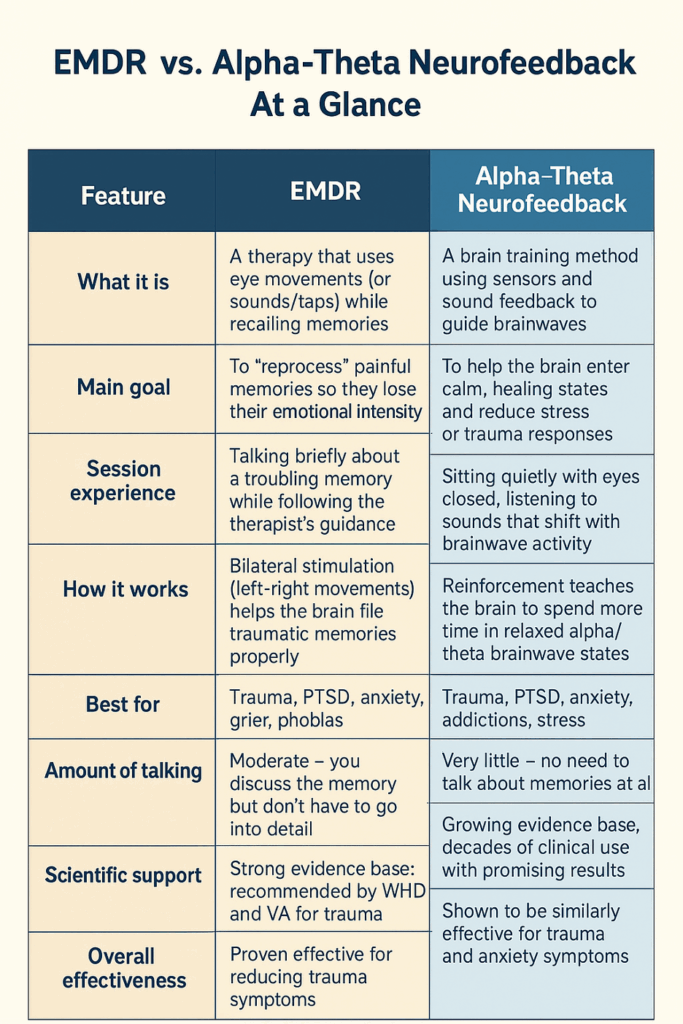
If you or someone you love struggles with trauma, anxiety, or stress that feels stuck, exploring these evidence-based approaches with a qualified professional may open the door to lasting relief. For a side-by-side comparison of these effective trauma and anxiety treatments, please see the infographic below.
Ready to take the next step? Contact me and the team at Awakenings to explore how EMDR or neurofeedback can help you move beyond trauma and reclaim peace of mind.